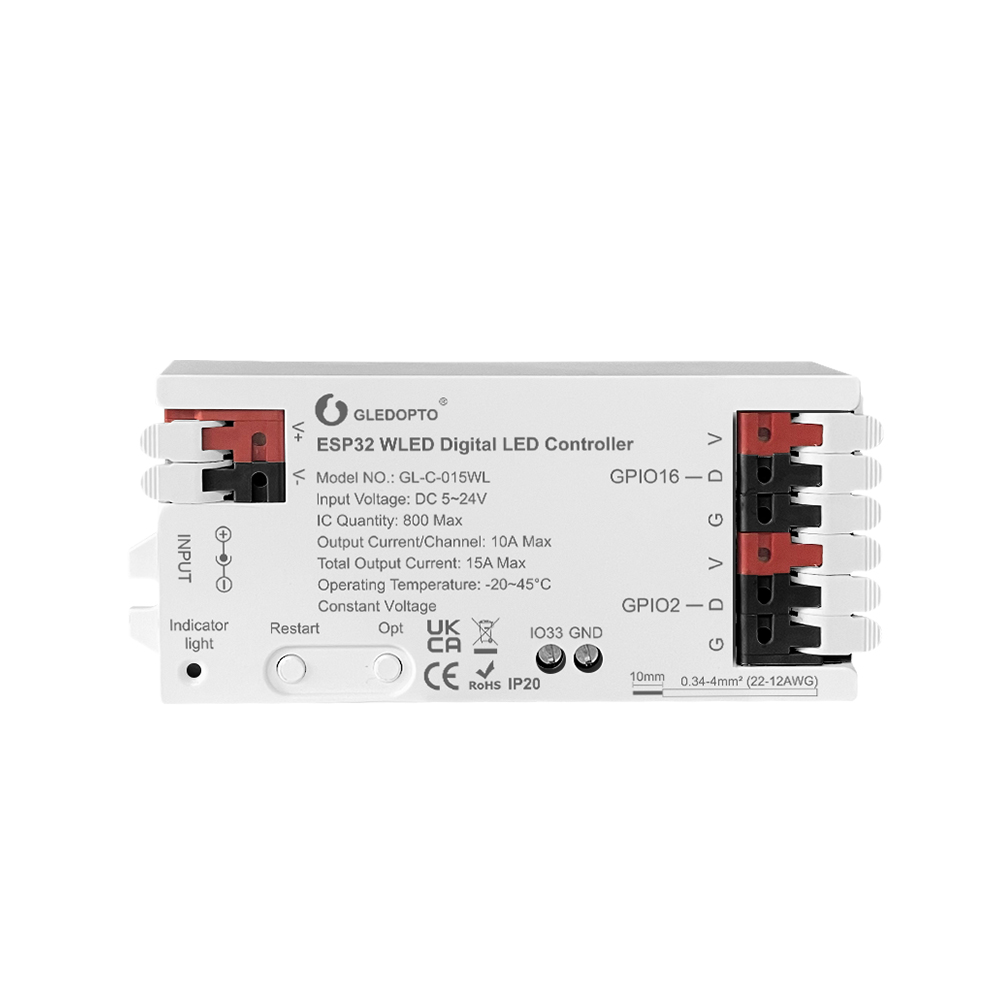
GL-C-015WL
Gledopto GL-C-015WL ESP32 WLED Controller 15A without Mic
SG Seller — ships same/next day — Local Warranty
Buy on Shopee →Overview
The GL-C-015WL runs WLED firmware pre-installed on an ESP32. It is the no-microphone variant of the 15A series — the correct choice for permanent installations where no sound-reactive effects are required and you do not want a microphone present in the enclosure. Three output channels: GPIO16 and GPIO2 for primary and secondary addressable strips, and IO33 as an extended GPIO for additional segments or sensor inputs.
15A total output, 10A per channel, handles medium to long addressable strip runs. The on-board relay cuts strip current to near-zero when WLED is off. Connect power, connect your strip to GPIO16, join WiFi — live in under two minutes. OTA updates via the WLED web interface.
If you need a built-in microphone, see the GL-C-015WL-D (Micro-B UART) or GL-C-016WL-D (Type-C UART). For a more compact controller with a mic at 10A, see the GL-C-010WL.
Technical Specifications
| Model | GL-C-015WL |
|---|---|
| Chip | ESP32 (dual-core, 240MHz) |
| Wireless | WiFi 2.4GHz (802.11 b/g/n) — no Zigbee |
| Firmware | WLED (pre-installed) — also accepts ESPHome |
| Input Voltage | DC 5V – 24V (constant voltage) |
| Total Output Current | 15A max (shared across all channels) |
| Per-Channel Output | 10A max |
| Output Channels | GPIO16 (primary) · GPIO2 (secondary) · IO33 (extended) |
| Max ICs | 800 |
| Microphone | None — no microphone fitted |
| Firmware Updates | OTA via WLED web interface |
| Standby | Strip relay off — near-zero strip current draw when off |
| Dimensions | 108 × 45 × 18mm / 60g |
| IP Rating | IP20 (indoor) |
| Operating Temp | −20°C to +45°C |
| Safety Mark | N/A — not Safety Mark certified |
Supported LED Strip Protocols
The GL-C-015WL supports all single-wire addressable (NeoPixel-style) protocols. It is not compatible with analogue (non-addressable) LED strips.
| Protocol | Notes |
|---|---|
| WS2812B / WS2812 / WS2813 / WS2815 | Most common — 5V or 12V variants |
| SK6812 (RGBW / RGBNW) | 4-channel including white |
| WS2811 | 12V addressable, 3-LED pixel groups |
| SM16703P | Compatible single-wire protocol |
| TM1814 | RGBW, 12V |
| FCOB / COB addressable | Check WLED device page for configuration |
Maximum 800 ICs per output. For longer runs, inject power at multiple points along the strip. The third channel IO33 allows an independent segment for architectural installations where two strips are not sufficient.
Home Assistant Integration
WLED integrates with Home Assistant via the native WLED integration — no YAML, no custom component. Once the controller is on your network, Home Assistant auto-discovers it and creates a light entity with full brightness, colour, and effect control.
For installations that need deep ESPHome automation — binary sensors, custom inputs, or native HA entity types beyond lighting — the ESP32 can be reflashed via OTA or via the ESP32 boot pins if you open the enclosure.
Supported control methods: WLED web UI · WLED iOS/Android app · Home Assistant (WLED integration) · MQTT · HTTP JSON API · E1.31/Art-Net DMX
Wiring — Addressable LED Strip
For a standard single-wire addressable strip (e.g. WS2812B at 5V or 12V):
| Terminal / Pin | Connect to |
|---|---|
| V+ (input) | PSU positive (5V, 12V, or 24V DC) |
| V− (input) | PSU negative / ground |
| GPIO16 (data) | Strip DIN (data in) — primary channel |
| Strip GND | Shared PSU ground (run alongside data wire) |
| GPIO2 | Second strip DIN — secondary channel |
| IO33 | Third strip DIN — extended channel |
Maximum total load is 15A across all channels simultaneously. At 12V with WS2812B at 9W/m: 15A ÷ (9W ÷ 12V) ≈ 20m before derating. Apply 20% thermal headroom. For runs over 5m, inject power directly at the strip. Use a constant-voltage PSU rated at least 20% above total strip load.
FAQ
Why choose a controller without a microphone?
In a permanent installation — inside a wall chase, above a false ceiling, or inside a sealed enclosure — a microphone picks up HVAC noise, compressor hum, and mains interference rather than music. For installations where AudioReactive effects will never be used, leaving the microphone out eliminates a potential noise source and simplifies the WLED configuration. The GL-C-015WL is otherwise identical in performance to the mic-equipped variants.
What is the difference between GL-C-015WL and GL-C-015WL-D?
The GL-C-015WL-D has a built-in digital microphone for music-reactive effects and a Micro-B UART port for serial firmware flashing. The GL-C-015WL has neither. All output specs — 15A, three channels, WLED firmware, ESP32 — are identical. Same price.
Does this work without a hub?
Yes — WLED runs fully local over WiFi. No Zigbee coordinator, no cloud account required. Control via the WLED web UI, iOS/Android app, or Home Assistant integration.
Can I add a microphone later?
Not to this unit — the microphone is a hardware component soldered to the board. If you decide you need music-reactive effects, the GL-C-015WL-D or GL-C-016WL-D are the correct alternatives. They are available separately.