The Problem With a Single Coordinator
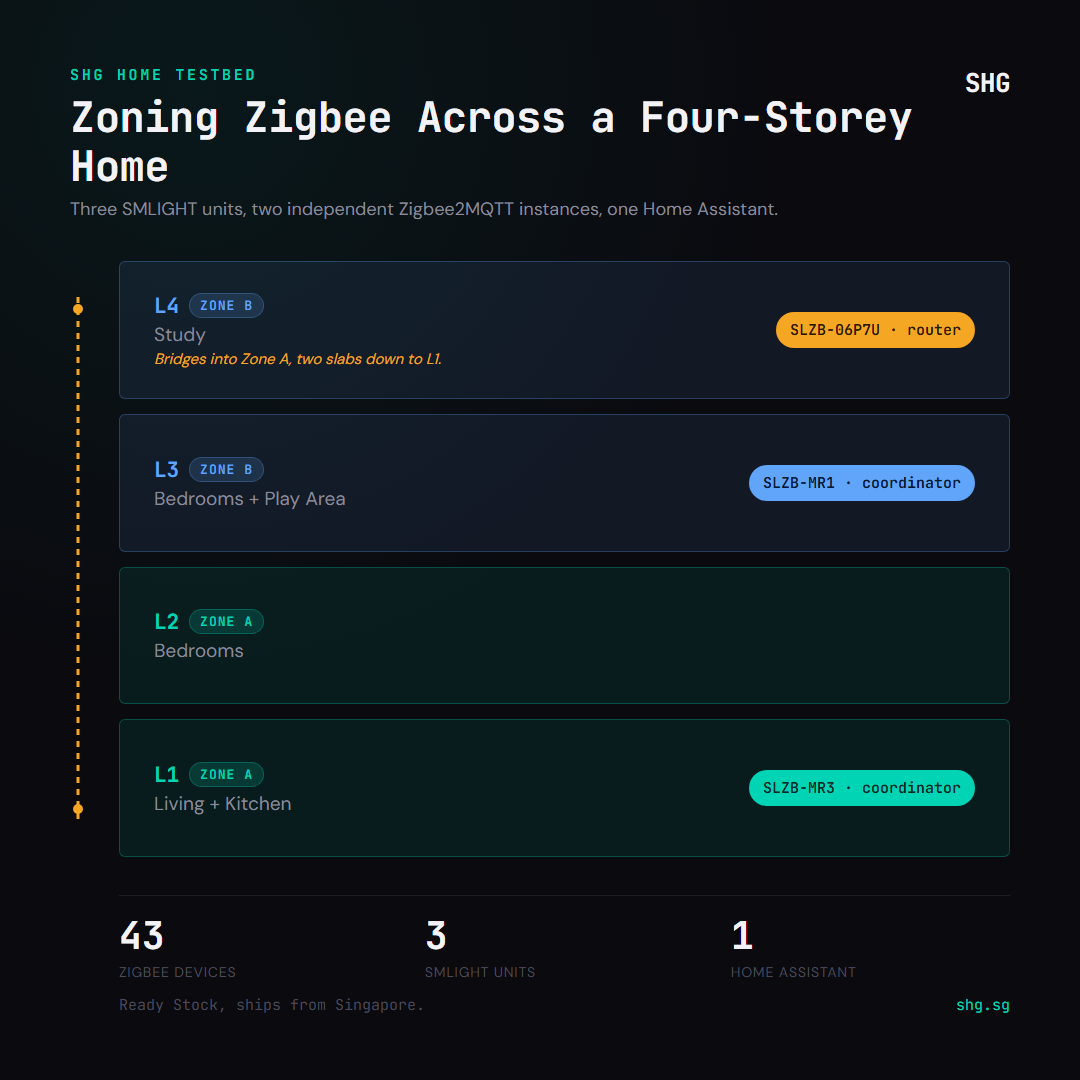
Our home is a four-storey property with concrete slabs between every floor and brick interior walls. That construction heavily attenuates Zigbee signal between levels, while coverage on a single floor is comparatively easy. Level 1 is the ground-floor living and kitchen area. Level 2 holds bedrooms. Level 3 holds more bedrooms and a shared play area. Level 4 is a study that also doubles as the network equipment room.
Run a single coordinator anywhere in a building like this and it has to push a signal through up to three concrete slabs to reach the far end. That single fact drove the whole topology.
Splitting the Mesh in Two
Rather than have one coordinator strain to cover four floors, we run two independent Zigbee2MQTT instances, each with its own SMLIGHT coordinator.
An SLZB-MR3 sits on Level 1 and coordinates the instance covering Levels 1 and 2. It also runs as our Thread border router. An SLZB-MR1 sits on Level 3 and coordinates a separate instance covering Levels 3 and 4. Both are dual-radio units, so neither is limited to a single job.
The Third Unit's Different Job
A third unit, an SLZB-06P7U, sits on Level 4, two concrete slabs above the Level 1 coordinator: exactly the distance at which a Zigbee mesh starts to struggle. Rather than stand up a third independent instance to cover a single level, we configured it purely as a router. It joins the Level 1 to 2 network as a repeater on the coordinator's channel, extending that mesh vertically through two floor slabs, so Level 4 end devices get a solid hop point without needing their own coordinator.
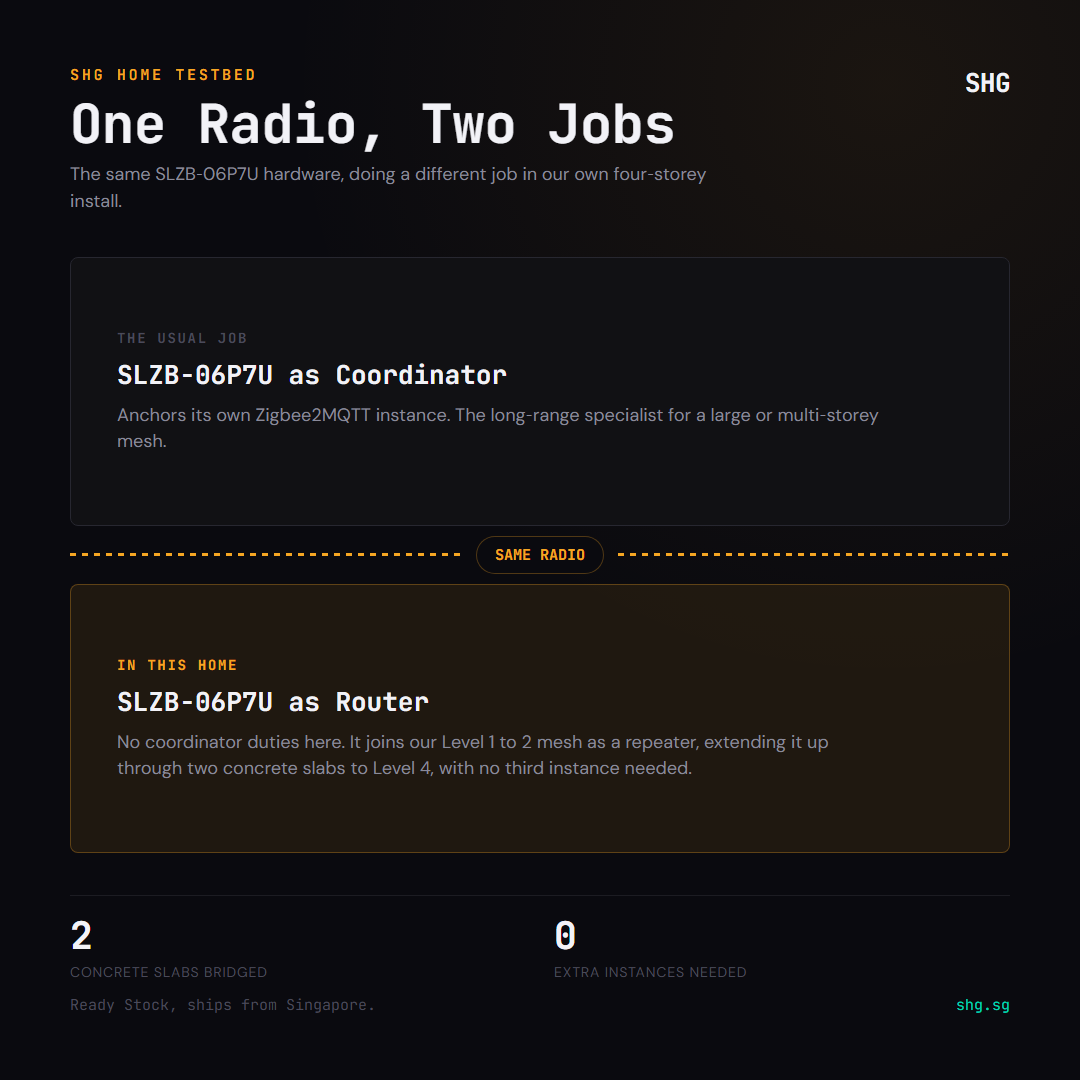
It is a good illustration of what SMLIGHT hardware can do: the larger units anchor a network, and the same core radio in a smaller role quietly solves a coverage gap, with no extra operational overhead.
One Home Assistant, Two Networks
Both Zigbee2MQTT instances run independently, each with its own MQTT topics, PAN and channel, but both feed into the same Home Assistant instance. The split is invisible at the automation layer: it behaves as a single network, with each device talking to whichever coordinator is physically closer.
The Numbers
The Level 1 to 2 network has 27 paired devices, including the Level 4 router unit. The Level 3 to 4 network has 16. In total, 43 Zigbee devices, coordinated by three SMLIGHT units.
If you are planning a multi-storey Zigbee mesh and want to talk through the topology for your own place, reach out directly. We are based in Singapore and run everything we sell in our own home before it goes on the shelf.